Before You Set Out: A Venue Details Checklist
Use this venue details checklist to confirm hours, entry rules, arrival routes, and amenities before you travel, so you can decide whether the visit fits.
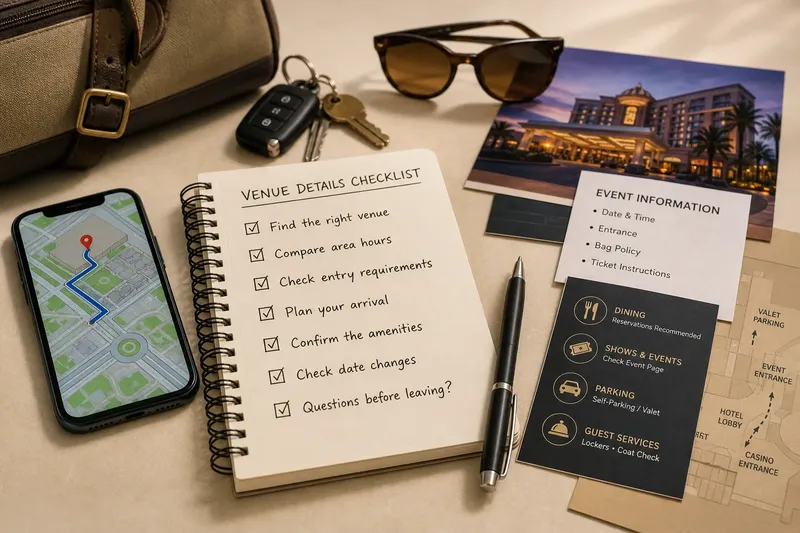
A venue details checklist helps you catch a closed entrance or an unavailable restaurant before you leave home. Compare the casino’s current information with the visit you actually have in mind, then decide whether the trip still makes sense.
Find the right venue
Start with the casino’s official site, not only a map listing or an old directory page. A resort may share a name with its hotel or entertainment complex, and a search result can point you toward the wrong property or entrance.
Compare the address with a map. Check the street, neighborhood, and any separate entrance details. If the casino sits inside a larger complex, note whether its public entrance is on a different side from the hotel lobby or event space.
Keep the exact venue name and address together in your notes. That simple pairing helps prevent a navigation pin from sending you to a similarly named destination.
Compare area hours
“Open” might describe the building, gaming floor, restaurant, bar, show, or hotel desk. Find the hours for the specific area you plan to use rather than assuming one general schedule applies everywhere.
Read the schedule for your intended day. Hours may differ on weekends, holidays, or event dates. If the venue says its schedule can change, confirm it rather than treating the posted hours as settled.
Dining may have a separate page, and reservations can have their own arrival window. If two official pages conflict, look for a newer dated notice or contact the venue through a published phone number or message channel. Ask about the exact entrance or service you need.
Check entry requirements
Look for the venue’s current rules on minimum age, acceptable identification, dress, guest registration, and bags. Requirements can vary between the casino floor, a restaurant, an event, and other parts of the property.
If you expect to enter a restricted area, confirm which identification is accepted. A photograph or digital copy may not meet the venue’s rule. If the policy is unclear, ask before leaving rather than trying to settle it at the door.
Check event-specific instructions too. A concert or private function may use a separate entrance, ticket check, or bag policy that does not appear on the general casino page.
Say you plan to attend an evening event and the event page lists a bag restriction that the general venue page omits. You check the event instructions and leave the restricted item at home; the expected result is reaching screening with an allowed bag instead of having to store it or reconsider entry.
Venue policies and local requirements vary. For a current rule, rely on an official notice or ask the venue directly.
Plan your arrival
“Easy to reach” is not a complete route. Check how you will get to the property, then how you will get from parking or a drop-off point to the entrance you need.
If you plan to drive, read the venue’s parking information. It may distinguish self-parking, valet service, accessible spaces, event parking, or vehicle restrictions. Check which entrance the parking area serves and whether it is available for your visit.
For transit, consult the local transit agency’s service information. A nearby stop does not tell you whether service runs at your arrival time or changes on weekends. For a taxi or rideshare, find the designated pickup and drop-off point instead of assuming every vehicle uses the main entrance.
If stairs, a long walk, or a particular entrance would affect your plans, check accessibility details directly. Look for accessible parking, a step-free route, elevators, and the entrance that reaches your destination. If the site leaves a gap, call and ask about that route.
Confirm the amenities
A property listing can make its amenities sound like one package, but each restaurant, show, or service may have separate hours and access rules. Check the specific page for anything that matters to your outing.
- Dining: If the restaurant page confirms your intended hours and reservation options, keep it in the plan; if not, choose another dining option or reconsider the visit.
- Shows and events: If the event page confirms the date, ticket instructions, and entrance, save those details; if any are unclear, contact the organizer or venue before traveling.
- Parking and transportation: If the listed option serves your intended entrance, use it; if it does not, select another route or ask the venue for directions.
- Hotel or lounge access: If access is open to you under the stated conditions, include it; if it requires a reservation or guest status you do not have, leave it out of the plan.
- Guest services: If a locker, coat check, or other needed service is confirmed, plan to use it; if it is unavailable or unclear, make another arrangement or travel without the item.
- Temporary notices: If a current notice confirms normal access, proceed with that route; if it lists construction, a closure, or a changed entrance, revise the route or postpone.
Broad labels such as “dining” or “guest services” do not confirm that a particular option will be available. Open the linked page for the restaurant, show, or service you actually want.
Check date changes
Old information can linger in search results, visitor reviews, and third-party listings. Give priority to a current notice on the venue’s official site, especially if it mentions renovation work, a temporary entrance, a private event, or a service change.
Check announcements close to your visit. A page you read earlier may not reflect a later closure or revised access instruction. Reviews can suggest useful questions, but treat them as accounts of someone else’s visit, not as current policy.
Note when you checked the information. If the trip depends on one restaurant or entrance, verify that detail again before departure.
Questions before leaving?
Are casino hours the same every day?
Not necessarily. Check the schedule for your intended day and the specific area you plan to visit, then look for holiday or event notices.
Can I rely on map listings?
Use a map to plan the location and route, but confirm hours and entry rules on the venue’s official site. If the sources disagree, contact the venue before setting out.
What should I check about parking?
Confirm the parking type, the entrance it serves, and any event-related restrictions. If an accessible route matters, check it directly rather than inferring it from a parking symbol.
What if a venue page is unclear?
Ask a specific question through the venue’s published contact channel. Include the date, approximate arrival time, and entrance or amenity you mean so the reply addresses your plan.
Make the go-or-skip call
Keep the confirmed details together: venue address, intended entrance, hours for the area you plan to use, entry requirements, and your arrival route. Add any amenity essential to the outing, and mark unresolved details as questions rather than assumptions.
Imagine you plan to drive to a casino for dinner and an event. You confirm the address, find that the event uses a separate entrance, check the restaurant’s hours, and learn that the parking area you first chose serves the hotel lobby instead. You select the event entrance’s listed parking option, save the event’s bag rules, and confirm that your identification meets the entry policy. The resulting plan is clear enough to follow; if the restaurant hours had remained uncertain, you would have had a reason to choose another dinner plan or postpone.
A venue details checklist works best when it separates confirmed facts from open questions. Save the official pages or contact details you relied on, and check for a fresh notice before departure if your visit depends on a particular entrance, event, or service.